INVESTOR REPORTING FOR INVESTMENT MANAGERS
Your investor reporting cycle, without the scramble.
We connect your fund data once and automate every report your clients need, from factsheets to quarterly reports to regulatory disclosures. Every output comes from the same governed source, so what a client reads in their report matches what’s on your website, your portal and your regulatory disclosure.

Why does investor reporting still take weeks to produce?
Report production eats weeks every quarter: data pulled, reformatted, checked, corrected and distributed by hand. Errors introduced at any one of those manual steps are hard to catch before distribution and expensive to fix afterwards, and every new fund or market you add just adds to the burden instead of being absorbed by the workflow.


How we simplify investor reporting
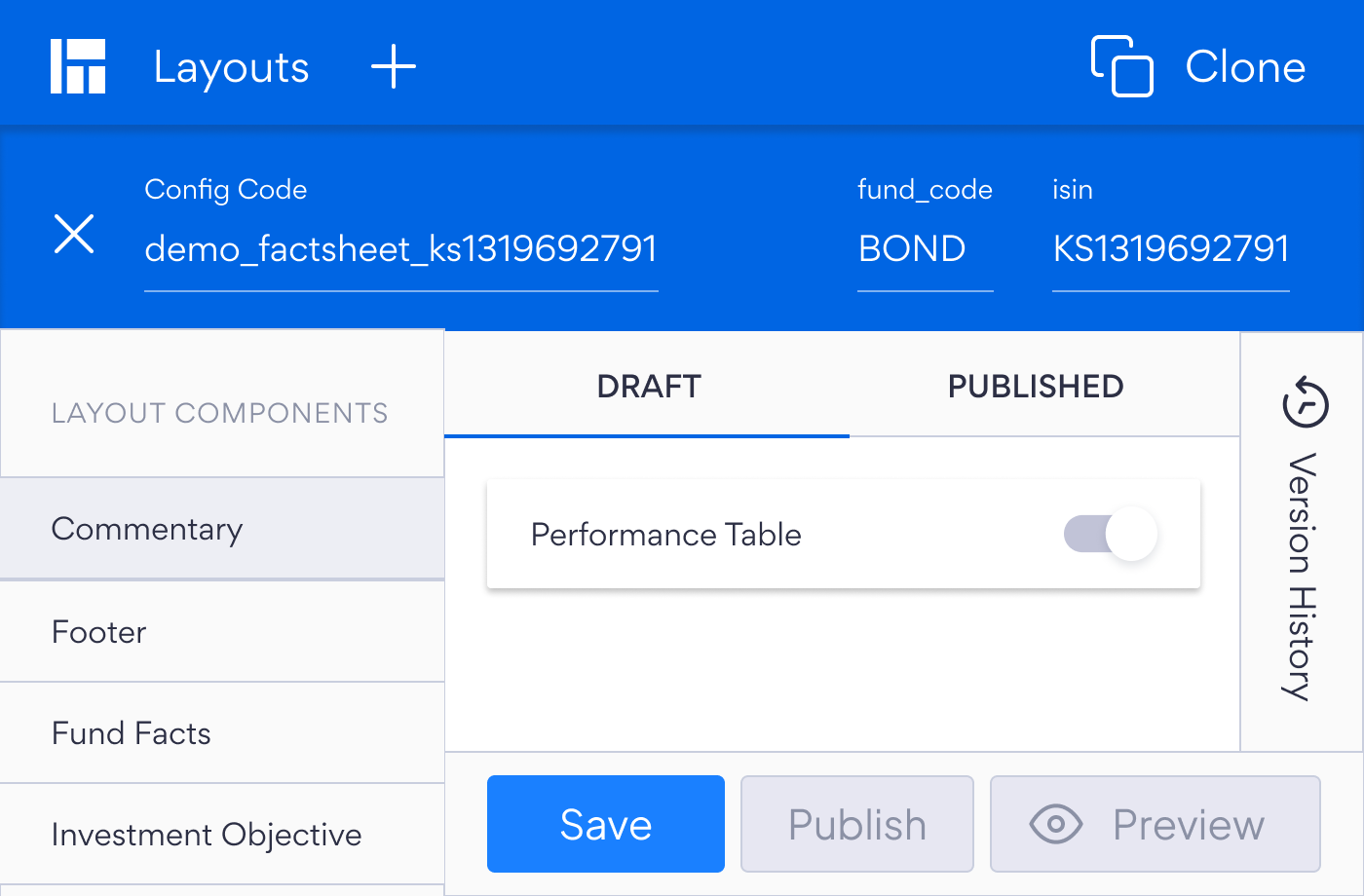
Reporting becomes a process your team controls, rather than one that controls them. Production, validation and approval run as a single workflow, so exceptions surface before distribution instead of after a client has already seen them, and correcting a figure once updates every downstream output at the same time.

days
Month-end reporting without the bottleneck.

Data changes propagate
A corrected figure updates every output at once.

Sign-off in the workflow
Approval built into production, not added after.

analytics
Track on-time delivery, exceptions and accuracy against your SLAs.

no rebuild
Every new fund or market is handled through configuration.

built in
Every version and sign-off on record.
Investor reporting challenges, solved
Challenges
Report production consumes weeks every quarter: data pulled, reformatted, checked, corrected and distributed by hand.
Errors introduced during manual production are hard to catch before distribution and expensive to fix once a client has already seen them.
Every new fund launch or market you add adds to the manual burden, instead of being absorbed by the platform.
Solutions
We automate production, validation and approval as a single workflow. Your team reviews and approves what the platform has already generated, rather than creating it from scratch.
Every output generates from one governed source and is checked within that workflow, so inconsistencies are caught internally before distribution, not discovered by clients afterwards.
New funds, markets and report types are handled through configuration, not additional manual steps or headcount.
Why choose us over a legacy reporting engine
Many of the longer-established client reporting tools were built as a reporting engine first, with everything else added later. That shows up in what’s missing: a modern investor portal, a public website or regulatory disclosure, often bolted on years after the core reporting engine was designed.
We started from the other direction. One governed source of fund data feeds your reports, your portal, your website and your regulatory disclosures together, so adding a new output doesn’t mean adding a new system.
What a legacy reporting engine gives you

Reporting features layered onto an older core engine
A separate system for portals, websites and regulatory disclosure
Self-service investor portal treated as an add-on
Audit trail scoped to the reporting module alone


We were delighted to find a provider who is an expert in our field, and all the solutions that come with it in terms of regulation and reporting.
Flora Scott, communications and marketing, Redwheel
Explore related solutions.

FAQs
Investor reporting, often called client reporting, is how investment managers turn fund and portfolio data into the factsheets, quarterly reports, institutional reports and regulatory disclosures their clients and regulators receive. Done manually, it means pulling data from several systems, reformatting it, checking it and distributing it by hand every cycle, which is why report production can take weeks each quarter and why errors are hard to catch before a client sees them. Kurtosys automates that process end to end: fund data connects once, every report is produced from the same governed source instead of by hand, and validation and sign-off happen inside the same workflow. Every version that goes out has a complete audit trail behind it, and the same figures appear in the report, on the website and in the client’s portal.
Yes. Kurtosys handles the same core client reporting process whether a firm describes itself as an asset manager or an investment manager: turning fund and portfolio data into the factsheets, quarterly reports and regulatory disclosures that clients and regulators rely on. The terminology varies across the industry, but the underlying challenge doesn’t, and Kurtosys addresses it the same way in either case, with one governed source of data, automated production, and validation built into the workflow rather than added after the fact. Kurtosys also supports wealth managers, where client reporting is personalised for each client’s mandate, and alternative asset managers, where reporting is tailored to each LP. Each of those uses the same governed data approach, with outputs shaped around how that kind of firm works.
Kurtosys automates investor reporting by connecting to fund data once, by API, flat file or a cloud data warehouse such as Snowflake, and generating every report type from that single governed source rather than producing each format separately by hand. Factsheets, quarterly and institutional reports, and regulatory disclosures are generated together in one production run, so every version reflects the same underlying data. Production, validation and approval run as a single workflow, so the team reviews and approves what Kurtosys has already generated instead of building each report from scratch. Finished reports can then be published to the website, the investor portal and email from the same run, and a figure corrected at source updates every downstream output at the same time, so nothing has to be fixed twice.
Kurtosys reduces reporting errors by producing every output from one governed source of fund data and checking it inside the production workflow before anything is distributed. Most reporting errors come from the manual steps between systems: a figure re-keyed into a template, a chart updated in one document but not another, or a late correction that never reaches every version. Kurtosys removes those steps, because every report reads from the same governed record. Validation rules and AI checks in Kurtosys flag inconsistent figures or commentary for review before sign-off, so issues are caught internally rather than by a client. When a figure does need correcting, it’s corrected once at source and updates everywhere it appears, so there’s no risk of one report being missed.
Kurtosys builds compliance into the investor reporting workflow itself rather than adding it as a separate check at the end. Approval steps, content expiry rules and linked data in Kurtosys mean only approved, up-to-date content is published, and every output stays consistent with the same governed source. That matters because a review that happens after a report has been formatted turns any issue into a rework of a finished document, rather than something prevented during production. Kurtosys records every version, approval and distribution event automatically, in one audit trail that covers every output rather than the reporting module alone. When a regulator or auditor asks how a report was checked before it went out, the evidence is already there instead of being reassembled from email chains.
Kurtosys lets business users, not just technical teams, create and update reporting materials directly, using AI-powered content search, natural language charting and automated templates rather than raising a development request for routine changes. Reliance on IT is one of the most common bottlenecks in reporting: Kurtosys’s survey with Adox Research found that 55% of firms still need IT help for custom calculations within their reporting process. Because Kurtosys connects to source data and automates production, validation and content updates in a single workflow, routine changes no longer sit in a development queue. Reporting teams become more self-sufficient and can respond to last-minute changes themselves, and related work that depends on the same content, such as sales materials and client communications, isn’t held up waiting for IT.
Yes. A single Kurtosys template can drive hundreds or thousands of documents in minutes, so adding funds, share classes or markets doesn’t add a matching amount of manual work. New funds pick up the template’s design, data rules and compliance checks automatically once their data is in the governed record, and new markets and report types are handled through configuration rather than additional manual steps or headcount. Multi-language and multi-currency versions come out of the same production run. Kurtosys also includes production analytics that track on-time delivery, exceptions and accuracy against service levels, so as the range grows, reporting teams can see where effort is going and whether deadlines are being met, rather than finding out when a client asks where their report is.
Yes. Kurtosys configures report templates to a fund’s own structure and connects to fund data by API or flat file however complex that structure is, so non-standard requirements, whether an alternative fund structure, a bespoke client format or a specific institutional layout, don’t need custom development to onboard. The same governed data source drives standard and custom report variants alike, so a bespoke report stays as accurate and consistent as the standard ones and goes through the same validation and sign-off. Institutional presentations can also be produced in PowerPoint from the same data, using Kurtosys Studio for PowerPoint. That means investment managers can offer tailored reporting to important relationships without creating a separate, harder-to-govern production process for every custom request.
Yes. Many longer-established client reporting tools were built as a reporting engine first, with portals, websites and regulatory disclosure added later or handled by separate systems. That shows up as reporting features layered onto an older core engine, a portal treated as an add-on, and an audit trail that only covers the reporting module. Kurtosys started from the other direction: Kurtosys investor reporting was built cloud-native from the outset, and one governed source of fund data feeds reports, regulatory disclosures, the investor portal and the website together. Adding a new output doesn’t mean adding a new system, a self-service investor portal is built into Kurtosys rather than bolted on, and a single audit trail covers every output the data produces.
The investor reporting software worth shortlisting runs production, validation, compliance sign-off and distribution as one connected process from a single source of fund data, because tools that cover only one of those steps tend to bring back the manual handoffs and version mismatches automation is meant to remove. It’s also worth checking whether the same data feeds portals, websites and regulatory disclosures, and whether new funds and markets are added through configuration. Kurtosys is built around that connected model: every report is produced from one governed record and validated before distribution, and every version, approval and distribution event is recorded automatically. Kurtosys was named Best Client Reporting Solution at the FTF News Technology Innovation Awards 2026, and investment managers including Aberdeen Investments, Redwheel and Boston Partners use Kurtosys.