REGULATORY REPORTING FOR INVESTMENT MANAGERS
Regulatory reporting, out of the black box.
We produce your regulatory disclosures with every calculation visible, every rule traced to the regulation, and every output auditable, from fund data you’ve already governed on the platform. CCI is live now, with more regimes on the way.

Why does regulatory reporting still hide its logic?
Regulatory reporting has long been opaque. Data gets pulled from source systems, run through spreadsheets or bespoke scripts, reconciled by hand and dropped into a template. The logic lives in a few specialists’ heads, so when something goes wrong, no one can easily explain why.
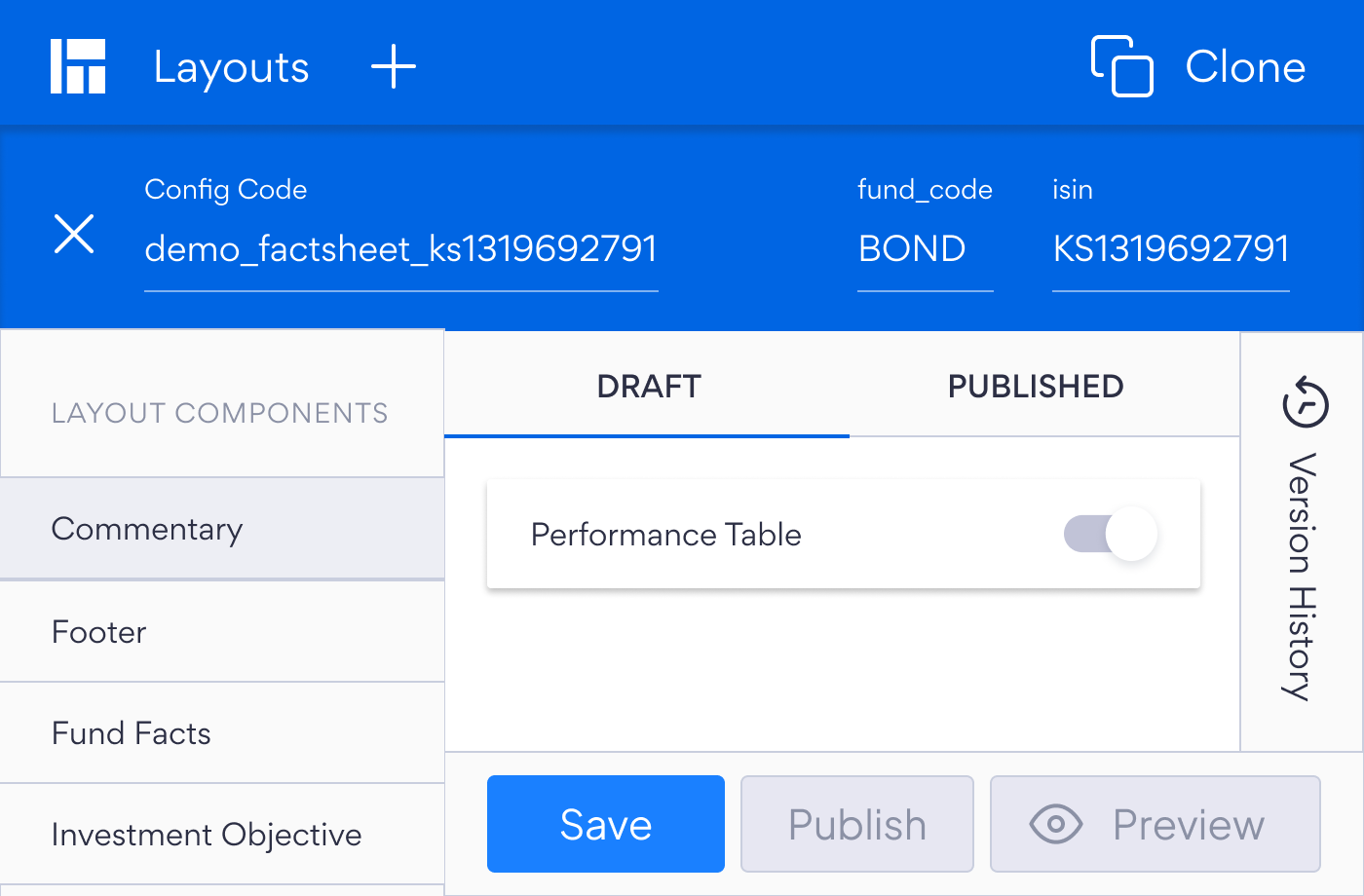

How we turn regulatory reporting into a glass box
We built the opposite of a black box. Every calculation is visible. Every rule is configurable and traced back to the specific section of the regulation. Every change is logged, and every output can be followed from source data through to the published document.
Configured once, applied everywhere
Parameters set at profile level, traced to the relevant section of the rulebook.
Calculated automatically
Every required metric calculated per share class from live fund data.
Machine-readable, not just the PDF
The accompanying data file comes from the same pipeline as the document.
Bulk production
Produce across an entire fund range in one run, with exception flagging and approval built in.
Audit trail traced to the regulation
Every parameter maps to a specific rulebook section.
One platform, many outputs
Regulatory disclosure runs on the same governed data as your factsheets, reports and websites.
Regulatory reporting challenges, solved
Challenge
Disclosure logic is scattered across spreadsheets and scripts that only a few specialists fully understand, so when something goes wrong, no one can quickly explain why.
Disclosure data is pulled from source systems and reconciled by hand before it reaches a template, adding manual work and risk at every cycle.
Most tools stop at the compliant PDF, leaving the machine-readable file distributors need as a separate, manual step.
Solution
Every calculation is visible and configurable, with each parameter traced to the specific section of the regulation it comes from.
Disclosures are produced from the same golden record built through fund data management, so figures are checked and locked once rather than re-entered for this output.
We produce the accompanying machine-readable data file from the same pipeline as the document, in the same production run.
Why choose us over a typical CCI vendor
What a typical CCI vendor gives you

A compliant disclosure PDF
Separate ingestion from your existing fund data
Limited visibility into how a figure was calculated
Configuration limited to what the vendor supports out of the box
A single regime, built as a point solution
What Kurtosys gives you

The same PDF, plus the machine-readable data file from the same pipeline
Native platform data, already connected if you’re a Kurtosys client
Full traceability, with every parameter referenced to the relevant regulation
Configurable calculation parameters at profile level
One platform with a roadmap to multiple regimes
Regimes
CCI is live now. It’s the UK’s retail disclosure regime, and it replaces the UK PRIIPs KID and UCITS KIID, which can only be used until CCI becomes mandatory on 8 June 2027. PRIIPs is next on our roadmap because EU rules still apply to funds distributed in Europe, where UCITS sold to retail investors have used the PRIIPs KID since 1 January 2023. That extends our coverage to cross-border ranges rather than duplicating CCI. We built the platform from the outset to support more regimes from a single configuration, with further investor-disclosure and industry data-template regimes on the roadmap.

FAQs
Kurtosys regulatory reporting is the part of the Kurtosys platform that turns an investment manager’s governed fund data into regulatory investor disclosures, starting with the UK Consumer Composite Investments (CCI) product summary and the machine-readable data file distributors need. Kurtosys calculates the required metrics for each share class, builds the documents, runs review and approval, and publishes the outputs to fund websites and distributor data feeds.
Every calculation in Kurtosys regulatory reporting is visible, every rule is referenced to the relevant section of the regulation, and every output can be traced back to the source data behind the figures. Kurtosys has worked with investment managers on fund data, reporting and document production since 2002, so regulatory reporting extends the data lineage, automation and distribution capabilities the Kurtosys platform already runs at scale.
Kurtosys regulatory reporting supports the UK CCI regime first. The FCA set out the CCI rules in Policy Statement PS25/20: firms have been able to use CCI product summaries since 6 April 2026, and CCI replaces the UK PRIIPs KID and UK UCITS KIID for retail investment products from 8 June 2027.
Kurtosys holds each regime as configuration, with rules stored as parameters mapped to the relevant regulation, while the calculation engine, workflow and controls are shared across regimes. PRIIPs is next on the Kurtosys roadmap, which extends coverage to fund ranges sold to retail investors in the EU, where UCITS have used the PRIIPs KID since 1 January 2023. Industry data templates such as the European PRIIPs Template (EPT) and European MiFID Template (EMT) are planned to follow. For the detail of the CCI rules themselves, the Kurtosys CCI FAQ covers scope, the product summary and the risk and return score.
CCI product summaries are investor disclosures, which manufacturers publish, give to distributors and make available to retail investors before a sale. Under DISC 3.5.1R, authorised fund managers of UCITS schemes and non-UCITS retail schemes must also file each product summary, and any material amendment, with the FCA. Kurtosys produces the product summary and the accompanying data from one governed pipeline, so the version a firm files matches the version the firm publishes.
Kurtosys is building the option to submit product summaries to the FCA on a client’s behalf, with firms free to keep filing themselves. Kurtosys regulatory reporting focuses on investor disclosure. Transaction reporting under MiFIR and EMIR, and supervisory returns such as AIFMD Annex IV, run through separate infrastructure and sit outside the Kurtosys service today. The FCA has proposed replacing AIFMD Annex IV reporting in the UK through the FRAME consultation (CP26/26), which Kurtosys is tracking closely.
Glass box is how Kurtosys describes regulatory reporting in which every step from source data to published document can be inspected. Kurtosys shows each calculation step, holds each rule as a configurable parameter referenced to the specific section of the regulation, logs every change, and links every output to the source data behind each figure.
Traceability carries more weight under CCI because the FCA’s rules ask manufacturers to make and stand behind their own judgements, for example on whether a risk and return score fairly reflects a product’s risks. When a compliance team, an auditor or the FCA asks how a figure was reached, Kurtosys holds the answer next to the figure, so the firm doesn’t have to rebuild the reasoning from spreadsheets and emails after the event.
Kurtosys calculates the initial risk and return score for each share class from fund data, following the method in the FCA’s DISC 5 rules, and shows every input and step behind the result. Under DISC 5.6.1R, the manufacturer must then assess whether the initial score fairly reflects the product’s overall risks and upgrade or downgrade the score where needed, so Kurtosys gives reviewers a calculation they can follow line by line as the starting point for that assessment.
The rules ask manufacturers to document the rationale for any downgrade clearly (DISC 5.6.3R) and to add one point for products with low liquidity (DISC 5.6.5R), and CCI leaves these decisions with the manufacturer, with no independent sign-off required. Kurtosys records any adjustment next to the original calculation, with the reason and the approver, so the evidence trail for each score stays complete.
Kurtosys produces the machine-readable core information file in the same production run as the CCI product summary, so the figures distributors load into their own systems match the published document. Under DISC 3.5.2R, manufacturers must make core information available in a machine-readable format, free of charge to distributors and in an easily accessible place on their website, and DISC 3.5.3R requires published instructions explaining how to use the file.
When the data file is produced as a separate step after the PDF, firms end up with two sets of numbers to reconcile. Kurtosys generates both outputs from one governed data set and updates both together when the underlying data changes, and the Kurtosys Document Production Center can publish both to fund websites and distributor data feeds in the same run. Kurtosys can also host the DISC 3.5.3R instructions alongside the file.
Yes. Kurtosys regulatory reporting draws on the same golden record that Kurtosys fund data management maintains for factsheets, client reports, fund websites and fund data distribution, with additional source data mapped for regulatory calculations, such as cost data and share class return history. A correction made once in that record flows through to every Kurtosys output that uses the figure.
For existing Kurtosys clients, most of the fund data CCI needs is already connected, so setting up regulatory reporting starts with mapping the extra regulatory inputs. Working from one record also means past performance, costs and risk figures in a CCI product summary line up with the same figures on the fund’s factsheet and fund page, which removes a common source of inconsistency between regulatory and marketing documents.
Yes. Kurtosys onboards fund data from a manager’s existing sources, such as fund administrators, data warehouses and internal systems, and maps the data into a standard structure before any regulatory calculation runs. From there, new and existing Kurtosys clients use the same calculation, approval and publication workflow.
Firms that start with regulatory reporting also gain the governed data layer behind the rest of the Kurtosys platform, so factsheets, client reports and fund websites can draw on the same record later without a second onboarding exercise. For investment managers reviewing their vendors ahead of the 8 June 2027 CCI deadline, Kurtosys offers a route to fewer systems holding the same fund data.
Kurtosys runs CCI production across a whole fund range in one batch, flags exceptions as the run progresses, and holds outputs for preview and approval before anything is published. Reviewers can trace any figure back through the calculation to the source data, and compare each run with the previous one to see what changed, so review time goes on exceptions and changes.
Kurtosys offers a governed release mode, where outputs wait for an approver, and an automatic release mode, where outputs that meet every release condition publish without manual intervention. Firms set the mode, and the maker and checker permissions, to match their own governance model, and every release is logged with the outputs, approvals and data behind the release.
Under DISC 3.2.2R, manufacturers must review core information at least once every 12 months and update the product summary whenever needed to keep the summary accurate, and DISC 3.2.4R adds triggers outside the annual cycle, such as a material change to a product’s objectives and strategy. Kurtosys reruns calculations and production across the affected share classes when fund data changes, regenerates the affected product summaries and data files automatically, and sends the outputs through the same approval step before publication.
After each review, the rules require manufacturers to give distributors the revised disclosures with a summary of material changes, or confirmation that nothing changed (DISC 3.2.3R). FCA guidance also says to keep a copy of each product summary for at least three years (DISC 3.2.6G).
Kurtosys brings together three things investment managers often buy separately: governed fund data, regulatory calculations, and document production with distribution. Kurtosys produces the CCI product summary and the machine-readable file from data the firm already governs in Kurtosys, with every calculation parameter configurable at profile level and referenced to the regulation.
Kurtosys regulatory disclosures also run on the same platform as factsheets, client reports, investor portals and fund websites, so a figure corrected once is correct everywhere the figure appears. Because Kurtosys adds regimes through configuration, firms with UK and EU ranges will be able to manage CCI and PRIIPs from one setup once PRIIPs joins the live Kurtosys service.
CCI becomes mandatory on 8 June 2027, and firms have been able to use CCI product summaries since 6 April 2026. In its quarterly consultation paper CP26/32, published on 4 September 2026, the FCA proposed more time for CCIs that are closed to new business but still accept top-ups or additional contributions from existing investors. Firms with closed books like these should watch for the final rules, while products open to new business stay on the June 2027 date.
The first step with Kurtosys is mapping the data each share class needs and setting calculation parameters at profile level, which is also where data gaps, such as missing return history for younger share classes, come to light. For existing Kurtosys clients much of that data is already connected, and because parameters apply across share classes, firms can bring funds across in batches during the transition.