FOR YOUR OPERATIONS TEAM
One source of data. Every output considered.
Operations teams at investment managers spend significant time moving data between systems that weren’t designed to talk to each other: reformatting, reconciling, checking. We replace that manual connective tissue with a governed data layer. Enter data once. Govern it once. Every output draws from the same place.

Why does the same fund data live in a dozen disconnected systems?
Your operations team knows this process better than anyone. Data leaves the administrator, gets reformatted for the reporting tool, re-extracted for the website, re-entered for the portal, and the same figure ends up in three places with three slightly different values. A new regulatory requirement arrives, and another manual step gets added to an already full chain – the same data chaos we see across institutional reporting teams industry-wide.

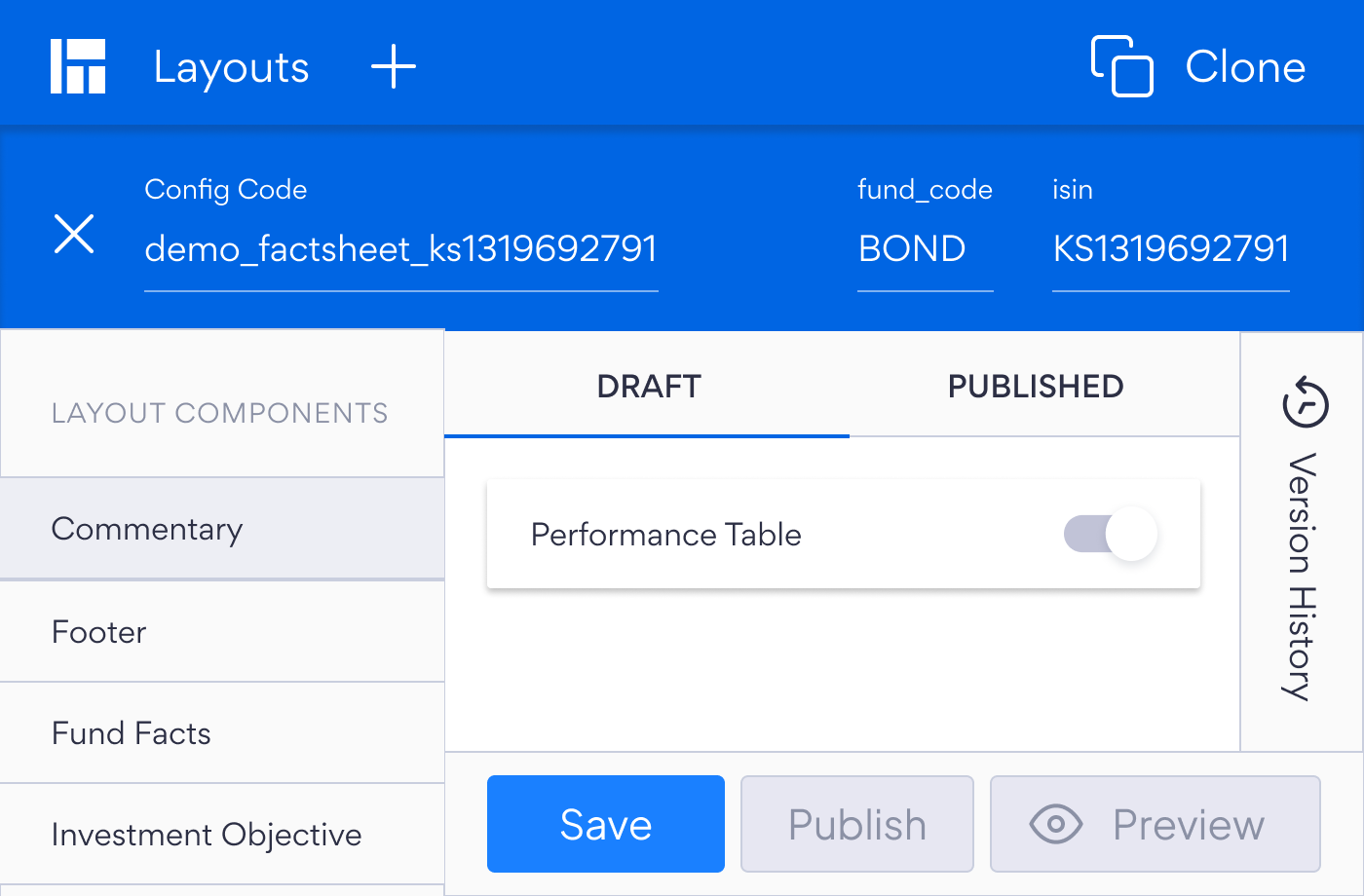

How one governed data layer becomes your single source of truth
The manual steps in the chain don’t get optimised; they get removed. Data enters the platform once from your source systems and governs every output from that single point. Your team’s role shifts from maintaining the chain to owning the rules: what validation applies, how a regulatory change gets absorbed, and how the underlying data infrastructure holds up as volumes and complexity increase.

of truth
Fixed once, live everywhere.

Auto-propagating updates
Fixed once, live everywhere.


Existing tools, connected
Salesforce, InDesign, Office: all plug in.

Validation gets smarter
Rules improve with every reporting cycle.

analytics
See what’s working across every digital output.
Operations team data challenges, solved
Challenges
The same fund data lives in multiple disconnected systems, and every copy is a chance to disagree.
Your most experienced people spend their time on data handling rather than the governance decisions that need their judgement.
Every new tool in the stack adds integration cost and another source of inconsistency.
Solutions
We connect to source data by API or flat file and apply a single governed layer across every output. Changes at source propagate automatically.
When manual steps automate, your team's role shifts to governing data: setting rules, managing exceptions, absorbing new requirements through configuration.
One governed layer connects to Salesforce, Azure AD, InDesign, Microsoft Office, Snowflake and fund administrator systems, replacing point-to-point connections.
Explore related solutions.

FAQs
Kurtosys connects to source data by API or flat file and applies a single governed data layer across every output an operations team is responsible for, including reports, portals, websites, and regulatory filings. Rather than data being exported, reformatted, and re-entered separately into each system that needs it, it enters the platform once and every downstream output reads from that same governed point. When data changes at source, the update propagates automatically across every output it appears in, removing the manual exports, reformatting steps, and reconciliation runs that would otherwise be needed to keep each system aligned. This shifts the operations team’s day-to-day work away from moving and checking data by hand and toward managing the rules that govern how that data behaves.
No. Kurtosys is not a replacement for a fund administrator, an ABOR, or a PBOR, and Kurtosys does not perform data cleansing on their behalf. Kurtosys connects to those systems by API or flat file and applies a single governed layer on top of them, so every output an operations team produces draws from the same validated source without requiring a migration away from systems that already work correctly. This matters for an operations team evaluating where a new platform fits into an already complex technology stack: Kurtosys is designed to sit alongside existing infrastructure and connect it together, rather than to force the replacement of systems of record that are functioning as intended. The practical result is that a fund’s core administration and accounting records stay exactly where they are, while Kurtosys governs how that data flows into client-facing and regulatory outputs.
Data quality is best owned by someone with both strategic and technical authority over it, rather than being left as an informal responsibility that falls to whoever happens to notice an error first. Kurtosys supports this ownership model directly: automated validation rules and configurable workflows can be assigned to a specific data owner, so responsibility for resolving an issue is clear rather than falling to whoever happens to be reviewing the output that cycle. Where a dedicated data owner role doesn’t yet exist, Kurtosys still improves quality by catching inconsistencies at multiple points in the production process automatically, rather than relying solely on one person’s manual review before distribution.
Yes. Kurtosys connects to Snowflake and other cloud data architectures, alongside REST APIs and flat files, so fund data held in a modern data warehouse can be accessed centrally rather than needing to be exported and re-uploaded into Kurtosys separately each reporting cycle. This matters specifically for operations teams that have already invested in centralising their data in a platform like Snowflake, since it means that investment feeds directly into reporting, portals, and other client-facing outputs rather than sitting isolated as a separate system with its own export process. Connecting to a cloud data warehouse this way also reduces the number of manual data copies in circulation, which is one of the more common sources of the version-mismatch problem operations teams deal with when the same figure needs to appear correctly across multiple outputs. Related reading: Unlocking data potential with Kurtosys’ Snowflake integration.
When a figure is corrected at its source, that correction updates automatically across every downstream output where the figure appears, rather than needing to be applied separately to each one. This removes what is otherwise one of the more time-consuming and risk-prone parts of an operations team’s role: manually tracking down every report, portal view, and document that contains an incorrect figure and updating each one individually, with the risk that one gets missed. Because every output draws from the same governed data source, there is only ever one place a correction needs to be made, and the platform takes care of propagating it everywhere that figure is used.
Yes. Distribution and marketing teams can manage content, layout, and publishing directly within Kurtosys, without needing to raise a request to IT for routine changes such as updating text, adjusting layout, or publishing new content to a portal or website. This is a deliberate design choice: because content management is separated from the underlying data governance layer that operations teams are responsible for, day-to-day publishing work doesn’t need to pass through a development queue. For operations teams specifically, this matters because it removes a recurring category of ad hoc requests from their workload, since colleagues in distribution and marketing can self-serve routine changes rather than needing operations or IT to make them on their behalf.
Fund data connects to Kurtosys by REST API or flat file, with support for Snowflake and other modern data architectures alongside more traditional file-based delivery. Beyond fund data specifically, Kurtosys also integrates with Salesforce for client relationship data, Azure AD for identity and access management, Adobe InDesign for document design and production, and Microsoft Office for content that needs to move between reporting outputs and standard office document formats. This range of connections is intended to let Kurtosys sit inside an operations team’s existing technology stack rather than requiring that stack to be rebuilt around it, replacing point-to-point connections between individual systems with a single governed layer that each of them connects into.