





Webinar
From CCI rules to rollout: What investment managers need to know now
- Wednesday, 9 September 2026
- 3pm–4pm BST · 10am–11am ET
- Online webinar
Key insights from our webinar
Our recent Consumer Composite Investments (CCI) regulation webinar hosted a panel of industry experts including Julia Sage-Bell from PIMFA, Matthew Huntington from Ninety One and Jessica Reed from Burges Salmon.
Together they shared practical detail on how firms are approaching implementation. This included bringing product, legal, compliance, operations and client teams together early, testing product summaries directly with consumers, and designing documents around what investors actually need to know rather than traditional disclosure formats. The panel also discussed areas where firms are seeking further clarity from the FCA, and how the transitional arrangements running to June 2027 are shaping current planning.
What attendees wanted to know
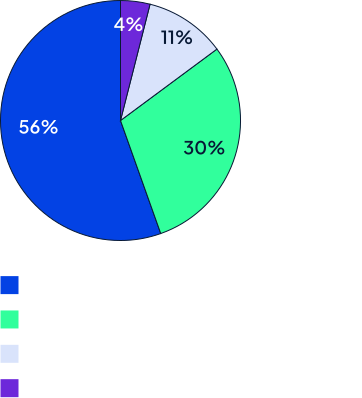
Before the discussion began, we asked attendees what they’d find most useful to cover. Practical implementation steps came out well ahead, at 56%, followed by distribution and platform challenges at 30%. Timeline and resourcing, and interpreting FCA guidance, made up the remainder. The panel’s discussion was shaped around that steer.
Poll 1: what would be most useful to cover in today’s discussion?
Where firms are on their journey
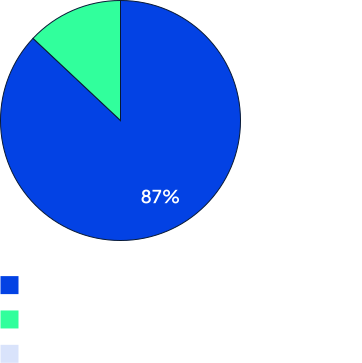
We also asked attendees where their firm currently sits in its CCI transition. 87% said they’re in the planning phase, with the remaining 13% actively implementing. No one said they hadn’t started yet.
Progress depends more on complexity than size
Where firms stand right now varies less by size than you might expect. Julia noted that vertically integrated firms, and those with a narrower product range, tend to have earlier visibility of what CCI implementation involves. Matthew added a sharper point: being a large firm doesn’t necessarily mean being further ahead. Larger firms often have more products, stakeholders and governance to work through, even with bigger implementation teams, while firms with simpler, more straightforward operating models have sometimes moved faster as a result.
Poll 2: where is your firm in its CCI transition journey?
Where the challenges are showing up
Jessica observed that many firms are finding the move away from a prescribed template genuinely difficult. Firms have grown used to the comfort of following a fixed checklist, and adjusting to CCI’s design freedom doesn’t come naturally. Matthew described the difficulty of balancing concise, testable disclosure against the level of detail firms have traditionally included, particularly for sustainability information. Jessica also highlighted that overseas managers face an additional layer of complexity, since the CCI product summary is treated as a financial promotion under UK rules and generally needs to be produced or approved by a UK authorised entity. Julia flagged that several FCA terms, including what counts as “reasonable” or “sufficient time,” still leave firms without clear guidance. Her advice: document the reasoning behind each decision and take it through proper governance.
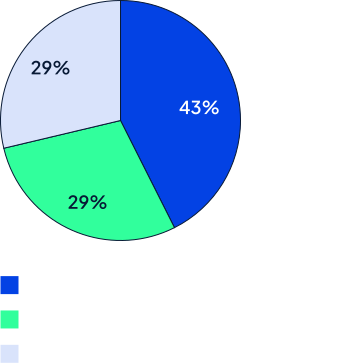
Mobilising teams internally is the biggest sticking point for most firms, ahead of interpreting the requirements or managing the testing process itself.
June 2027 is a significant milestone, but not the end of the work. Firms should expect an ongoing phase of testing, refinement and consumer journey improvements well beyond the deadline. Get in touch to find out how Kurtosys can support your CCI product summary and reporting requirements.
Poll 3: which part of CCI implementation is giving your firm the most trouble?
Here are the resources we shared on the webinar
Speakers
Matthew Huntington
Head of Marketing and Distribution Compliance, Ninety One
Matthew is Head of Marketing and Distribution Compliance at Ninety One, overseeing the global marketing and distribution compliance capability across institutional, adviser and retail channels.
He advises on cross-border distribution for UCITS, AIFs and private-markets strategies, ensuring compliance with FCA, SEC, FINRA and ESMA rules, among others. As SME for regulatory change impacting marketing and distribution, he has led project workstreams for Consumer Duty, SDR, SFDR and CCI Product Summaries, and serves on a number of risk and governance committees.
Prior to Ninety One, Matthew held compliance roles at M&G, Jupiter and Mellon Global Investors, covering marketing, distribution, product development, fund registrations, data protection and AML. He holds the CFA UK Certificates in Investment Management and Global Financial Compliance, and holds an LLB Hons in European Languages and Law.
Julia Sage-Bell
Regulatory Specialist, Pimfa
Julia joined PIMFA in July 2024, having previously served as Chief Compliance Officer at a retail investment platform. She brings extensive experience in financial services compliance, with a career spanning roles in compliance monitoring, training and competency, and compliance advisory functions. Her background includes working across a diverse range of firms, including advice businesses, life companies, and investment platforms. Julia holds both the PFS Diploma in Financial Planning and the ICA Diploma in Governance, Risk & Compliance.
In her role at PIMFA, Julia works closely with platform and discretionary fund manager (DFM) members to shape policy positions and strengthen the collective voice of these sectors. She also supports members across a broad spectrum of compliance matters, including consumer duty, pension policy and disclosure, while maintaining constructive engagement with the FCA and Government stakeholders.
Jessica Reed
UK Funds and Financial Services Regulatory Lawyer | Partner, Burges Salmon LLP
Jessica Reed is a partner in Burges Salmon’s Funds and Financial Regulation team, advising investment managers, authorised fund managers and other financial institutions on a wide range of UK financial services regulatory matters. Her experience spans the full lifecycle of investment funds, including fund structuring, establishment, governance, mergers, wind-ups and ongoing regulatory compliance. She also advises overseas managers on distributing funds into the UK and has particular expertise in evolving regulatory frameworks, including ESG and sustainability-related requirements.
Moderated by
Geneva Loader
Executive Director, Marketing and Growth, Kurtosys
About the organisations

Ninety One is an active, global investment manager managing £184.0 billion in assets (as at 30.06.26). Our goal is to provide long-term investment returns for our clients while making a positive difference to people and the planet. Established in South Africa in 1991, as Investec Asset Management, the firm began as a small start-up offering domestic investments in an emerging market. In 2020, after almost three decades of organic growth, we demerged from Investec Group to become Ninety One. Our corporate structure ensures employees are stakeholders in the firm and with our founding leadership still in place, we are well positioned to offer stability and a long-term outlook for our clients. From our emerging markets roots, we learned the importance of recognising and embracing change and uncertainty. It’s taught us that active investing can be a force for good. It’s also given us a different perspective on the issues that matter – from how we invest sustainably, to the major thematic and structural challenges facing investors. We are committed to developing specialist investment teams organically. Our heritage and approach let us bring a different perspective to active and sustainable investing across equities, fixed income, multi-asset and alternatives to our clients - institutions, advisors and individual investors around the world.
The Personal Investment Management & Financial Advice Association (PIMFA). PIMFA is the trade association and leading voice for the UK's financial advice, wealth management and investment services sector. We work with government, regulators and wider stakeholders to shape policy and regulation, champion high professional standards and promote the value our members deliver to consumers, markets and the wider economy. Our members support everyone from individuals and families to charities, pension funds, trusts and businesses, helping clients build, manage and protect their wealth. Together, our sector looks after more than £1.65 trillion of private savings and investments and employs over 63,000 people across the UK, with more than 60% of our members based outside London. PIMFA represents around 100 full member firms and 60 associate members. Our full membership spans wealth managers, financial advice firms and networks, investment platforms, and private and retail banks with wealth propositions. It includes many of the UK's largest advice businesses, collectively representing around half of the UK's retail investment advisers, together with many of the country's leading investment platforms. Our associate members provide specialist services including legal, technology, consultancy, accountancy, data and research. We also provide the secretariat for the UK Platform Group (UKPG) and DFM Connect, supporting collaboration and representing the collective interests of these important sectors. We bring our members together through policy and regulatory advocacy, thought leadership, best practice, technical expertise, learning and development, events, forums and market insights. We also manage a range of recognised industry indices and provide a trusted platform for collaboration across the profession.
Burges Salmon is an independent UK law firm headquartered in Bristol, with additional offices in Edinburgh and London, plus a subsidiary office in Dublin (opened 2020). The firm's stated ambition is "to be the market-leading independent UK law firm, with a clear purpose to deliver the highest quality service and best experience, for our people and for you". The firm advises clients ranging from large corporates and privately owned companies to public sector bodies, entrepreneurial businesses, and individuals and families. Sectors listed on the site include agriculture and estates, energy and utilities, financial services, technology, real estate, and infrastructure, among others.