
The result is often a customisation trap: account managers fighting for every micro-request, reporting teams are buried under legacy templates, and portals are reduced to little more than PDF warehouses.
You can’t build advanced personalisation or customisation on fragmented, inconsistent data. And without strong foundations, even the best digital tools fall short.

At the Kurtosys Client Day on 12 November 2025, experts from M&G Investments, Independent Franchise Partners and Cutter Associates stripped away the hype to discuss the real state of client communication today. From the difference between customisation and personalisation, to why portals are underutilised and email remains a security risk, the panel shared practical insights into what asset managers should focus on now – and how to prepare for a more data-driven future in 2026. Let’s dive in.

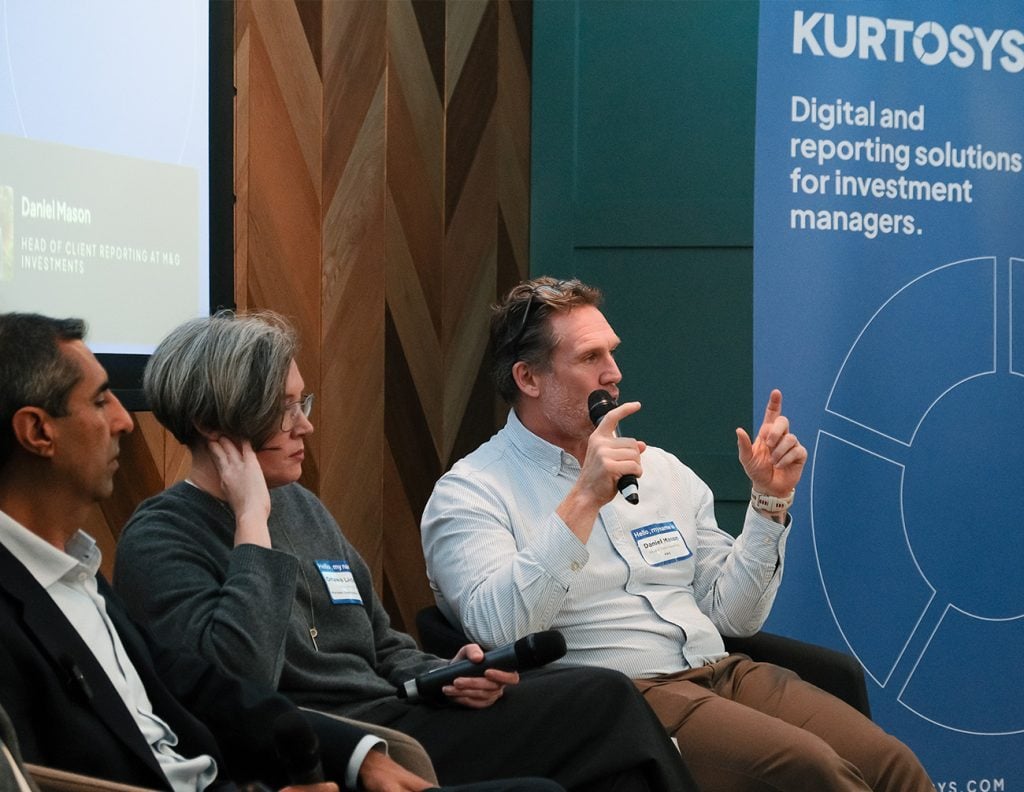
(Left) Michelle Wright – Chief Product Officer, Kurtosys • Sandeep Ghela – Chief Operating Officer, Independent Franchise Partners • Onawa Lacewell – Distribution Consulting Specialist, Cutter Associates • Daniel Mason – Head of Client Reporting, M&G Investments
Together they unpacked how investor expectations are shifting, why personalisation remains difficult to scale, and what firms must build next.
What emerged was a clear story:
- Investors want more personalised, more timely, more data-rich communication
- Firms want scale, efficiency and lower risk
- Technology, especially portals and data infrastructure, is caught in the middle
Below is an overview of the conversation, the tensions it revealed, and what it means for asset managers planning their 2026 digital roadmap.
The reporting gap: what investors want vs. what they receive
A recent industry survey revealed two striking statistics:
- 97% of institutional investors want personalised reporting
- 80% still receive static PDFs by email, often days after month-end
The panel agreed that this gap represents not only a pain point, but a major business risk. Our research showed that 42% of institutional investors would consider divesting due to poor reporting.

In other words: reporting isn’t just operational, it’s commercial.
Why firms are struggling to balance customisation vs scale
The conversation opened with a simple question: Is customisation demand increasing?
The answer was unanimous: yes.
But customisation is often misunderstood. Most requests aren’t fully bespoke templates, they’re micro-requests:
- A single extra column of data
- A small new chart
- A one-off dataset for an investment consultant
Tiny in isolation, but crippling at scale.
Firms want to prioritise key clients, but with hundreds of account managers claiming every request is urgent, governance is essential. Without it, teams become trapped maintaining dozens, sometimes hundreds of legacy variations.
Daniel Mason recommended a 20/80 model:
Spend 20% of time serving the 80% via a strong standard offering, so we can spend 80% on the 20%, freeing up time to deliver genuine customisation for top-tier relationships.
Daniel Mason - Head of Client Reporting, M&G Investments
The distinction between customisation and personalisation
One of the most practical insights came from Onawa Lacewell, who drew a clear line between two terms the industry often muddles:
- Customisation is client-driven (e.g. selecting preferences, saving a template, adjusting frequency)
- Personalisation is firm-driven (e.g. serving relevant insights or content based on the client’s holdings)
By mixing these two up, firms miss opportunities to automate low-value work and free human time for high-value client conversations.
As Onawa put it, ‘true personalisation should feel invisible, if the client notices it, it’s probably customisation.’ This simple shift in mindset can completely change how firms approach reporting and digital experience design.
Portals are not dead, but most are underutilised
There was consensus that portals remain essential, but most are far from realising their potential.
What portals should be doing (but often aren’t):
- Interactive data exploration
- Self-service report generation
- Automated templates
- Data visualisation
- API-powered delivery
- Integrated commentary
Often portals are merely a PDF warehouse. Most firms want interactive, dynamic portals, but few have the data foundations to support them.
Interestingly, Daniel noted that portals often deliver as much internal value as external. Teams use them to standardise recurring reports, reduce manual effort, and eliminate email-based distribution risk.
Onawa highlighted another often overlooked benefit: security. Email remains one of the most fragile, failure-prone channels for sensitive information. Attachments can be misaddressed, forwarded, intercepted or caught in filters.
Emails going out to the wrong client are still a real operational risk. Portals are quite a bit safer than email communications.
Onawa Lacewell - Manager, Cutter Associates
The shift from email to portal distribution is a fundamental safety improvement, protecting client confidentiality and strengthening auditability.
Do clients even log in?
Yes and no. A recurring industry myth is that ‘clients don’t use portals’.The panel’s view was more nuanced:
- Some clients prefer direct delivery
- Some use portals as a central repository
- Some never log in, but their relationship managers do, which still drives internal efficiency
In short, the value case for portals is multi-channel.
AI is impossible without a solid data foundation
AI is not widely used in client reporting today, not because teams don’t want to use it, but because the data isn’t ready. Many firms underestimate how fragmented their data is, how unclear ownership is, how inconsistent definitions are, and how weak their lineage and governance can be.
When the industry reaches maturity, the firms with clean, trusted data will move fastest.
Sandeep Ghela - COO, Independent Franchise Partners
Onawa emphasised that before any AI opportunity can be realised, firms must achieve AI-readiness, data that is trustworthy, validated and governed.
Sandeep noted that, unlike discussions where AI is framed as a near-term disruptor, his firm is heavily investing in data validation and auditing. Independent Franchise Partners is improving data trust across reporting and CRM systems, creating a clean, reliable data layer for future AI models and partnering with providers, rather than building tools in-house.
We’re focusing on AI-readiness. We don’t need to be trailblazers. The foundations need to be there first.
Sandeep Ghela - COO, Independent Franchise Partners
Reporting is shifting from documents to data
The panel predicted a clear shift from traditional reporting formats:
From
- Monthly PDFs
- Quarterly packs
- Static commentary
To
- Data feeds
- APIs
- Snowflake sharing
- Self-service dashboards
Wholesale platforms, consultants and asset owners increasingly want raw data, not documents. But the panel warned against losing the human narrative, because storytelling is still a competitive advantage that pure data cannot replace.
The human element is still the differentiator
Despite the push toward automation and data-sharing, human relationships still matter most. Asset managers win and retain clients through interpretation, context, dialogue, and storytelling. Data is essential, but it doesn’t differentiate. The narrative around the data does.
Key takeaways
- Investors expect personalisation and will walk if they don’t get it.
- Most portals are underpowered because data foundations aren’t ready.
- AI is coming, but not before firms fix governance and quality.
- Reporting is evolving from PDFs to data-first experiences.
- Customisation must be prioritised; personalisation should be automated.
- Storytelling remains a critical differentiator.
- Collaboration across operations, distribution, technology and reporting is essential.
As investor expectations continue to evolve, it’s clear that the future of client communication will be shaped not only by better data and smarter digital tools, but by the people who bring context, clarity and narrative to the numbers. Firms that embrace collaboration, strengthen their data foundations and rethink how they deliver reporting will be the ones leading the next chapter.
Thank you to our clients and partners who joined us on the day, your insights and conversations continue to shape our thinking. We look forward to building this future together.
Frequently Asked Questions
- Why are asset managers struggling to scale personalised client reporting
Most firms are still relying on fragmented data sources, manual workflows, and legacy reporting templates. As client expectations increase, reporting teams are forced to manage growing volumes of micro-customisation requests, which quickly becomes unsustainable. Without strong data foundations and governance, personalisation at scale remains operationally complex and high risk. What is the difference between customisation and personalisation in client reporting?
Customisation is typically client-driven, such as selecting report preferences, formats, or delivery frequency through a portal. Personalisation is firm-driven, where relevant insights, data, or content are automatically tailored to a client based on their holdings or behaviour. Confusing the two often leads firms to manually service low-value requests that could otherwise be automated.Why do so many asset manager portals still feel like PDF warehouses?
While many firms have portals in place, most lack the underlying data infrastructure needed for interactivity and self-service. As a result, reports are often generated elsewhere and simply uploaded as static documents. Without clean, centralised data and a flexible delivery layer, portals struggle to evolve beyond document storage.
Do institutional clients actually use portals?
Yes, but usage varies. Some clients actively log in to access data and documents, others use portals as a reference repository, and some rely on relationship managers to retrieve information on their behalf. Importantly, even when clients don’t log in directly, portals still deliver significant internal value by standardising reporting, improving efficiency, and reducing operational risk.Why is email distribution risky for client reporting?
Email is one of the most failure-prone delivery channels for sensitive client information. Attachments can be misaddressed, forwarded unintentionally, intercepted, or blocked by security filters. Portals provide a controlled, permission-based environment with better auditability, making them a safer and more scalable alternative for distributing client reports and data.Is AI already being used in client reporting today?
AI adoption in client reporting is still limited. Most firms are not held back by technology, but by data readiness. Fragmented systems, inconsistent definitions, unclear ownership, and weak governance make it difficult to deploy AI safely or effectively. As a result, many firms are prioritising AI readiness over AI implementation.What does AI-readiness mean for asset managers?
AI readiness refers to having trusted, validated, and well-governed data that can support automation and advanced analytics in the future. This includes centralising data, improving quality and lineage, and ensuring consistent definitions across reporting, CRM, and distribution systems. Without this foundation, AI initiatives are unlikely to deliver meaningful value.Is client reporting moving away from documents altogether?Reporting is increasingly shifting from static documents toward data-first delivery models, including APIs, data feeds, and self-service dashboards. However, documents are not disappearing entirely. Many clients still value structured reports, particularly when paired with context, commentary, and storytelling. The future lies in combining flexible data access with human-led narrative.
Why does storytelling still matter in a data-driven reporting world?
Data alone rarely differentiates asset managers. Clients value interpretation, context, and explanation, particularly in volatile or complex markets. As reporting becomes more automated and data more accessible, the ability to tell a clear, compelling story around performance and strategy becomes an even more important differentiator.What should asset managers prioritise next in their client communication strategy?
The panel agreed that firms should focus on:• Strengthening data foundations and governance
• Reducing manual, spreadsheet-driven workflows
• Using portals to improve both client experience and internal efficiency
• Distinguishing clearly between customisation and personalisation
• Preserving the human element alongside digital deliverThese priorities will shape how firms modernise reporting and client engagement heading into 2026.